Alexonomic's Outlook for 2013: South America

Yes, the Brazilians are still the centerpiece of South American economic growth, yet there are competitors arising. While Venezuala faces a period of uncertainty with the potential replacement of Hugo Chavez, Argentina offers a renewed challenge to the Falklands under Cristina Fernández de Kirchner.

Alexonomic's Outlook for 2013: Europe

Europe reminds many historians of conditions during the 1930s. Economically depressed countries are embracing extremist political parties with racial divide, riots, and anger as the symptoms. Currently, most of the population is aware of the European debt crisis. Although a serious as the economic crisis is, the side effects of lower economic output can be more serious.

Americans and their Guns

To stray from the Predictions of 2013 series, I did an infographic of the gun control debate raging in the US, along with some statistics. The objectives of Obama gun control rules come plainly from the White House publication on the topic. As one can see, the proposed regulations are quite practical.

Alexonomics' Outlook for 2013: Africa

Egypt has often been the focus of news in Africa as of late. The removal of Mubarak and election of Mohammed Morsi has proven to be an interesting turn of events, but the excitement is far from over. Morsi symbolically removed ties from the Muslim Brotherhood, but that move hardly removes the influence the party has on the President.

A guide to Environmental Economics

Often, articles will be conclusions with a few supporting facts that will often sway the reader. I find this problematic for two reasons. First, the reader does not have the chance to fully understand the topic because no background is given. Secondly, the reader doesn't really have an opportunity to disagree with the writer's conclusion if the reader has little to no knowledge of the topic.

Showing posts with label Economics. Show all posts

Monday, 9 September 2013

The Result of Every Nation Abolishing their Debt


Some readers have asked what would occur should every single government in the world just abolish, or default, on their debts. Although the answer may be simple to those who understand the global economy, for most it is quite a real question. If every single country in the world just decided to default on their financial obligations, the following would most likely briefly describe the general result. 
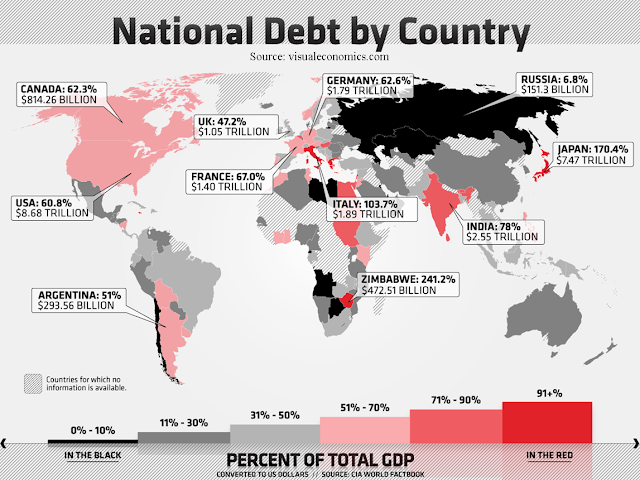
What if this was all eliminated? 

  • First realize that there are different governmental levels. Federal, State (Provincial) or Municipal (city). Each level has debt and obligations in the form of bonds. We’ll assume for the sake of the scenario that each level of government decides to default on their obligations completely wiping out their deficits and budget shortfalls.
  • This would wipe out the bondholders. Who are they exactly? Well institutional banks, international organizations such as the IMF or World Bank, could be another layer of government loaning to another (Federal to State/City does happen), personal investors, or even charities in the form of trying to keep a fund alive.
  • Why do you care? Well, banks invest the savings of their customers. This would completely wipe out the savings of most of the population, and destroy bank’s ability to issue credit. Why is credit needed? For almost everything from beginning a business, to buying a new car on payments, to buying a house with mortgages, you get the point. Bank’s would have a lot less liquidity and would essentially stop loaning.
  • International organizations who have now no fire power to help around the world with problems such as natural disaster to supplying rebels with the ammunition to overthrow their tyrannies would cease to exist. Why? They simply would have no money.
  • Personal Investors and people who invested in the bank or government bonds would see their entire life savings wiped out in most cases. This would flood the job market with anyone who was retired as they would be forced to work again.
  • The job market would be non existent as there would be no liquidity. Credit is used on a daily basis by millions of corporations around the globe to conduct daily business, like manufacturing plants securing parts in to continue production. Without credit this fiat currency based economy does not run. The money multiplier effect would cease to exist. The bank runs that would occur would destroy all banks. 
  • Governments may be debt free, but no one in their right mind would lend them money again. This would cut funding for many programs from Health Care, Welfare, to basic stuff such as police and fire fighter services.
  • With cutting to all these services as the government could not raise money from issuing bonds, the job market destroyed, bank runs causing the destruction of financial institutions, little taxation revenue, chaos would ensue.

    In simple terms, the above would be the answer to the question. The chain reaction should all governments default on their debt would be catastrophic, and most likely reset global economic activity a decade. 

Thursday, 1 August 2013

A Look at Ontario's Debt


Monday, 16 July 2012

All You Need is a Bit of Confidence


Have you ever had a good friend? This friend you know you can trust, you have faith in them, you feel as if you can tell them anything. This friend was there for you when there was a family death, and always went out of the way to ensure you were happy. However, lately your friend has been acting strange. They don’t communicate as much with you, and when they do it’s abrupt and brief, often going weeks without saying a word. The little surprises you had grown accustomed to are now gone; although wondering what’s occurring in your friend’s life you decide to not ask feeling it’s too much of a burden.

However, suddenly you discover your friend has been in trouble.  After a sudden event, drugs and alcohol had consumed your friend in a depressive state. Again, you decide that it is best to do nothing and continue on. Then you discover that your friend has been borrowing quite a bit of money to fund bad habits, and is in heavy debt. Again, doesn’t matter. However, the event that gets you involved is when you find out your friend has forged your signature for a line of credit they cannot pay.

Now you’re involved.

The result of this is probably little to no trust in your friend anymore, while at the same time an epiphany that you should have been there from the start – when the warning signs were present.
This is an analogy of a word that is repeated in financial news quite a bit –confidence. Consumer confidence, market confidence, is basically a measure of how much faith there is in the economy. Like the anecdotal friend, if the population has less confidence in the market the less chance individuals will take risks associated with improving or creating business.

The story also shows how trust between financial institutions and govern and the consumer have fallen. At first, banks were well trusted before 2007, and the consumer had been appreciating the relatively easy credit that could be gained through financial instruments such as line of credits or reverse mortgages. However, despite their being heavy warning signs of many living outside their means, the consumer continued to take the ‘gifts’ from the bank without hesitation. Then, 2008 occurred and suddenly the banks were bailed out by the government. The consumer distanced themselves from the banks and decided to let them figure it out themselves. Trust has continued to fall with the LIBOR scandal and various trading scandals such as UBS. This is the ‘drug and alcohol’ part of the analogy, as these scandals are eroding what faith the consumer had in financial institutions.

However, the consumer is starting to realize how they are tied to the banks. The governments rely on banks in many cases to provide budget funding to deliver on social programs that the consumer appreciates, or pay wages or supply pensions to the consumer. All of a sudden, austerity causes these programs to be slowed down or completely cut out. Again, this is when you realize the friend from the initial story has forged your signature – and now you must take action.

This analogy is far from perfect, but it does show the connection. Financial institutions are heavily connected to Western daily life, and their decline is beneficial to no one, except anyone who has been shorting them for the past 4 years. Instead of ignoring the issues and simply not trusting financial institutions, educate yourself about proper financial planning in your own life instead of simply taking the advice of someone else at face value.

Market confidence, like trust in friends, is very difficult to revive. With the past scandals that have taken place and especially with something as massive as LIBOR, it could take years. What happens without market confidence? Well let’s suppose I wanted to open a business. To open, I need capital of around $50 000, and could apply for the loan. However, I am unsure that the interest rates will stay the same, and with a worsening economy am less unsure that people will purchase my product, which would cause me to fall far into debt. Therefore, I do not take the risk – and decide to continue working at the government.

If I would of have had faith in the economy, I would of taken the loan and paid interest to the bank resulting in profits for them. I would have hired a few employees resulting in less governmental dependents, and my business (should it be profitable) provides more taxable revenue.

It’s all about confidence.

So, what can we do? Continuing with the analogy, instead of waiting for your friend to deteriorate into a worsening state, call them and ask what’s up – or maybe surprise them somehow. The meaning behind this is education about basic financial terms instead of simply taking a line of credit without full understanding. Do some research before making a financial decision such as purchasing a house, instead of buying one based on emotion without fully understanding the difference between a fixed or floating mortgage, or having a proper down payment. By being a more responsible consumer, you are assisting your friend, or the financial institutions in the long term.

How?

If you add stress to a bank, employees whose livelihoods depend on their divisions profit lines will feel forced to make wrong decisions that will most likely be profitable in the short term but devastating in the long term. No, I am not blaming the consumer for the illegal actions of others. However, I am assigning a value to ensuring you are financially responsible, and making sure you are not classified as a toxic asset on a bank’s balance sheet. Additionally, there is value to not supporting additional lending by government agencies in order to continue unsustainable social programs that add a marginal benefit to your life.

It’s a lot easier to not involve yourself in what seems to be a friend’s sole problem, but you’d wish you would have when all of a sudden you feel the after effects.


Reuters on confidence.
The end result of toxic assets.

Wednesday, 11 July 2012

LIBOR: The Syndication of Banks


Commonly known in the finance world, LIBOR is one of the main interest rates used in many calculations around the globe for all kinds of financial products. I believe one stat I read stated it is included in 800 trillion dollars’ worth of financial engineering.

However, most don’t know what all the fuss is about so I’ll quickly go through the basics. It’s already been summed up in many worthy publications which I’ll link below – but here is my take on it. The London Interbank Offered Rate (LIBOR) is an interest rate that is calculated for 10 different currencies and 15 borrowing periods. Each currency has a panel of banks that report their interbank lending rate, and this is reported to the British Bankers Association, which then reports to Thomson Reuters for the daily calculation. The rate is released around 11 am London time. 

Traders realized that if they could falsely manipulate the LIBOR rate, millions could be made even with a move of 0.01%. So, in accordance with bankers, some banks reported false interbank interest rates being charged in order to lower the LIBOR rate. I should reiterate quite a few banks engaged in this activity. For example the Royal Bank of Scotland reported lower interbank rates than healthier Banks even though it had been locked out of financial markets due to its financial condition.  Since LIBOR is used as the basis in most financial transactions, banks could then borrow money with lower interest rates and lend it out at higher rates. Also, trader’s having knowledge of what the LIBOR rate would be in the future allows more accurate predictions when deciding whether to buy or sell any financial instrument from any type of derivative to deciding whether to buy/short shares in a bank before reporting.

Why is this big deal? Well, the Economist labeled the lot of deviants Banksters while the Washington Post compared the dealings to that of a cartel. The comparisons are actually quite deserved, as these institutions should be competing with each other for business, not manipulate business through syndication. Adding to this, LIBOR was supposed to be a rate used as a basis for financial transaction – a non-biased number.  The whole process will now be placed under review as it has been corrupted.

How does it affect you? Well, if you contribute to any pension fund, have a mortgage, student loan, or are involved in almost anything that involves the stock market – you have been affected somehow. It will be really difficult to gauge the true cost of what has transpired, but the biggest cost has been market confidence – which has already been in free fall since 2008.

Simplistically, this is what has occupied the news outlets headlines over the past few weeks.


Here's some sources that go into far better detail: 
Telegraph             Washington Post            Economic Times            The Economist           Business Insider (thanks Reddit) 

Monday, 1 August 2011

Summary and Outlook on US Debt Crisis


The US is 14.5 trillion in debt in terms of national debt. The increases in spending because of bills passed like No Child Left Behind, Obamacare, and rising Social Security along with an expensive military to maintain are the drivers behind the increasing deficit. Basically, if the US doesn't cut any spending, the deficit will increase annually therefore the national debt continues to go skyward. That's the background.

There is a constitutional law that limits the amount of borrowing the US can do. Reagan increased it all the time, Clinton, Bush etc...Usually it passes like clockwork and no one really notices it. However, this time the Republicans wanted cuts. Which is fair, as they cannot afford the expensive programs they've been instituting. However, at the same time the Democrats wanted to increase taxes, which again is fair as the US has one of the lowest tax rates in the Western world.

John Boehner is the speaker for the Republicans and has been negotiating a deal with Obama. Obama has been fighting for tax increases and compromising with spending cuts. Boehner, due to the idiocy of populist politics and the rantings of the tea party, has declined to agree to any tax increases. The tea party is the main reason for this, a group of uneducated people who still think America's main threat is Obama being a closet Muslim. The risks of not getting a deal done is Moody's will downgrade the American debt from their precious AAA Rating causing turbulence in the markets, rising interest rates, and just general panic. The biggest fear though is of default, which would render America's currency less valuable in comparison to many of the other top currencies. Default is the worst fear, but it most likely will not happen.

Currently, Boehner has negotiated a deal that reveals Obama to be pretty spineless, as the deal that is expected to be announced is 2.1 trillion in spending cuts (good but not enough), a nonpartisan Budget committee to find more ways to slice the deficit down (good idea - should of happened years ago) and a two step plan for increasing the debt again when it has to be done which will involve more negotiated cuts. There will be no tax increases, which is very unfortunate as the US simply needs more tax revenue to pay their bills.

I realize I am biased against Obama but I am frustrated at him not standing up and getting some tax increases, 2.1 trillion in spending cuts isn't even enough (over 10 years). With straight line, that's 210 billion per year, which in terms of America's budget isn't good enough. Right now, if the deficit spending continues, interest payments will become America's largest annual expenditure (above military and Social Security).
Nobody doubts the tea party's effectiveness, they have succeeded n pushing the entire American spectrum to the right. Were they right? Hell no.

American tax revenue right now is around 14% of GDP. Right now, the rich contribute about 18% of total tax revenue, down from 30% around a (decade?) ago - I forget the timeline. This is the lowest percentage of tax revenue from GDP since the 1950s. Contrary to what most people think, Americans spend a ton of money on healthcare - I think it's above 15% of GDP and more than any of the wealthy nations. They have the largest military, which isn't cheap. In the last decade, they've engaged in 2 large wars. Obamacare adds to the cost, and really the legislation does nothing except give big pharmaceuticals more money. No Child Left Behind was shown as one of the most idiotic pieces of legislation by around 70 teachers (?) or something like that being caught in lifting average test scores so they would get higher salaries. And that bill cost a ton of money. Social Security costs far too much, and a lot of this is actually universal in the Western world. Part of the reason is the retirement age must be lifted. The 65 years old thing was based on old living expectancy (I think 67 at the time) - now I think most Western countries are around 75 - 80.

American government is too big, sure and they're spending like there's no tomorrow. But, taxation is actually at its lowest in a long time. And that ladies and gentleman is why were are in this mess. Republicans appease voters by lowering taxes while the Dems grab votes by offering social services. How can one continue to spend more money when you're not bringing in more? The answer is you cannot.

The Tea Party has a good central idea of government needs to be lessened - I agree. I agree that stimulus is never the answer and Keynesian economics don't work when you only practice in bad times. However, the riots and the idea of DON'T RAISE TAXES is something the Tea party is most known for and has Republicans catering them by refusing to raise taxes. Taxes NEED to be raised. They are just too low right now in the US. And taxes will be raised, it's only a matter of time before the government is forced too.

This is all of the top of my head, so look up the stats if needed - I'm pretty sure they're all close. If you want to know how to make money from this, short the American dollar and short any US Bank. Historically, when there have been low taxes on the rich there has been a quick boom followed by recovery. And we will enter the recovery stage sooner or later.