


Continual controversy, timeless dispute, uninterrupted dissension, endless altercations, incessant wrangling.
All these two word utterances could describe the Middle East. However, the Middle Eastern economy still continues, and offers growth opportunities in 2013 and beyond. Although many Middle Eastern countries have brought in large amounts of wealth from oil exports, the failure of properly investing in infrastructure and institutions have led to stunted economic growth.
There are few countries in the region that have broken the aforementioned trend. One of these countries is Israel, where growth has been relatively unaffected by the financial crisis of 2008, as the OECD predicts 2.9% growth in 2013 with 3.9% growth in 2014, while HSBC pegged Israel's 2013 growth at 3.3%, closer to the Israeli government's own prediction of 3.5%. Standard and Poor's stated that “the Israeli economy continues to generate solid economic growth" while keeping their credit rating at an envious A+, while Moody's kept their credit rating of Israel at A1.
The bond rating agencies and positive growth predictions are well founded. Israel has a GDP of $250 billion, or around $32000 per capita while their Debt/GDP ratio is below the OECD average of 78%. One of the leading reasons for the country's growth is their technology industry, which recently added Lockheed Martin to the many companies in the sector. A 2011 study by Ethosia estimated that the Israel tech industry employs almost 200 000, with that number most likely currently higher. Israel Aerospace Industries is the largest tech employer, with two defense companies follows (Elbit Systems and Rafael Advanced Systems), which HP and Intil both have more than 5000 employees, and IBM employing around 2000. Software companies lead the way, while hardware, Internet and telecommunication companies all have flourished. Additionally, it should be recognized that women occupy almost 40% of tech positions, a rare statistic for a Middle Eastern country.
To pinpoint a few interesting developments in Israel's tech valley was President Obama, who met with 7 different startups. One company created an exoskeleten suit that allowed a paraplegic to walk around a room while another company pitched a snake like device with a camera attached that could potentially find humans quicker in disaster zones. The Israeli Tech industry is living up to its nickname, the Silicon Wadi, as it continues to grow.

The future may be brighter for Israel not just economically, but geopolitically as well. With Iranian elections ending with the election of Mr. Hassan Rouhani, who has declared that Iran "will also reconcile with the world" and plans on seeking "constructive interaction with the world". Israel is not convinced, as Prime Minister Netanyahu has been cautious if not negative about Mr. Ahmadinejad's replacement. An opinionated article in the Jerusalem Post rejected the notion that Mr. Rouhani is a moderate, stating that "Hassan Rouhani is a cunning terrorist mastermind", who has been quoted naming Israel as a terrorist state and Hezbollah a legitimate political entity.
However, despite the negativity surrounding Rouhani, there are some good signs. Mr. Rouhani has said he will attempt to end infighting between the legislative and executive branches of government, calling for more cooperation to resolve the issues surrounding Iran. The call for cooperation is well backed by precedent, as Mr. Rouhani has been noted for building relationships between different Iranian political factions. In addition to this, Mr. Rouhani has called for more freedom for the Iranian people in terms of internet access, more freedom for journalists , and less interference from police and clergy members in personal lives of Iranian citizens.
This blog has covered Iranian issues before, going through the history of the country to note the reason behind tensions with the West and also how the current sanctions from the West have created economic problems such as inflation. In 2012 the Iranian economy contracted almost a full percentage point and 2013 saw additional contraction of 1.3%, while some analysts have pegged inflation at 25%. Besides Western sanctions reacting to the nuclear stalemate that have cut crude oil production to less than half of peak produiction, Mr. Ahmadinejad attempted to save the Iranian government $100 billion by ending subsidizations of gas, wheat, rice and other staple commodities which created obviously higher prices.
The economic problems will be the chief concern for Mr. Rouhani when he officially takes on the Presidency. With 14% unemployment, Mr. Rouhani has admitted that improving Iran's lacklustre economic performance will take time. This is well known fact to most Iranians as a businessman stated that the "supermarkets will soon look like they did in the war years. The colour of the shelves is fading. Foreign products are disappearing". This is almost a direct result of the subsidization cuts, which has hurt the lower and middle class. Already, Iran's parliament has discussed bringing the subsidization policies back. In addition to this, the subsidization of fuel was key to the manufacturing industry, which has been hurt with energy bills two or three times the usual cost. It is also interesting to note that Iran has stated India can use rupees to pay for an outstanding $1.53 billion debt in oil..
With Israel calling for increased sanctions and not ruling out a military option, Mr. Rouhani will face an immense challenge attempting to fix the Iranian economy. External geopolitical pressures over Iran's nuclear program will likely be the determinant of internal economic growth. Contrarily, neighbouring Iraq is painting a different picture of their future. Although violence has been getting worse as the UN stated almost 700 Iraq's were killed in May 2013 alone, some solid signs of economic improvement have occurred in Iraq.
Citigroup has launched a physical presence in the country looking to dip their toes into oil profits. Although the country still has violent problems along with government corruption, the economy did jump 8.4% in 2012 and is reported by the IMF to improve 9% in 2013. Although this most likely can be attributed to the large amount of oil produced, other signs are pointing to a positive business environment. Iraq's credit is 9% of GDP compared to 55% average to the middle east. Banks are attracted to the lending rates of around 12%, and the demand for physical expansion as there is only one ATM for every 100 000 Iraqi's and 900 bank branches in the whole of Iraq. Chapter Seven restrictions which did not allow the country to deal with all the countries of the world, will be lifted. Chapter Seven sanctions caused all Iraqi assets in international banks to be frozen.
Obviously, the major risk for foreign investment is violence. However, this risk can be mitigated as over 90% of violence occurs in seven of the 18 provinces. The other problem is corruption, as the country has been compared with North Korea and Afghanistan in terms of corruption. It is noticeable that these problems are relatively non-existent in Kurdish northern Iraq. Kurdistan has raised per capita incomes while keeping peace and has discovered oil reserves around 45 billion barrels. It is possible that Kurdish oil production will reach a million barrels per day by 2015. Constant talk of independence and squabbles with Baghdad are the only problems for the province, which do have legitimate chance of sparking into a conflict.
Afghanistan has responded similarly after American invasion. The World Bank has reported that 2012 saw 11% growth in Afghanistan, due to an exceptionally good harvest. This slowed inflation and Afghanistan is almost at food self sufficiency. However, the country faces momentous security concerns with the Americans vacating the country and the constant threat of the Taliban regaining control of the country through violent means. Elections in 2014 will most likely be accompanied by violence as Mr. Karzai is constitutionally barred from entering a third term in office. It is recognized that the Afghan National Security Forces is quite competent and has the ability to control the major cities and protect citizens against insurgency due to the enriched training received by NATO forces. For now, Afghanistan must concentrate on creating a more peaceful country by mitigating the Taliban threat.
Peace is not a term used much in Syria right now. The economy is the not exactly a major concern for Syria right now, as a violent multi faction civil war has caused The Economist to entitle an article on Syria "The death of a country". The Arab Spring protestors were attacked by the Assad regime with tanks, which sparked the conflict. As jihadists enter the country, it is hard to differentiate the different sides to the conflict. Economically, a Syrian economist predicted a decline by 10-20% in 2011 GDP while the Syrian pound has fallen from 50 pounds to the dollar to more than 200. Prices are rising while Syrian currency is almost worthless. In 2012 foreign trade fell by 97% with GDP dropping 30% in 2012 and another 10% most likely in 2013.
Syria's economic problems can be associated with the civil war, a war in which the world has suspected chemical weapons being used while millions are displaced. Personal stories such as a young 14 year old being brutally assaulted and murdered for making a small joke have horrified the world, which has caused the United States to take notice. While the US wishes to enforce a no fly zone, the Russians continue to supply the Syrian government with weaponry advocating for no involvement from the rest of the world.
Even as the opposition political group elects a new leader Ahmad Jarba, there is little belief that this conflict will end soon. Mr. Assad is too strong to simply lose the war, but too weak to defeat the many different types of rebels. Hezbollah, al-Qaeda, the Taliban all have members in Syria, along with other rebels with different beliefs. Disunity of the rebel forces will ultimately extend the violence in the country, and most likely increased concern by the international community could cause intervention.
 No stranger to international attention is Saudi Arabia, which recently made headlines after banning a man from an event for being reportedly too handsome. As the second half of 2013 looms, Saudi growth has become more moderate. A large stimulus package given by the Saudi regime stopped any Arab Spring action, as the economy is expected to grow around 4% in 2013. The Arab Spring has been profitable for the Saudi's, as the end in Libyan production along with turmoil in oil markets couple with sanctions in Iran have increased demand for Saudi crude.
Policy wise, the government has created a program which penalizes companies should they decide not to hire enough Saudi nationals. Construction fueled by the stimulus should accelerate growth, as economically the country is doing fine. The greatest complaint is the lack of woman's rights in the country, which is slowly being liberalized, admittedly at a snail's pace. The largest concern is succession, as there is controversy and speculation on who will rule the thrown when King Abdullah ends his reign.
There are many more countries that can be talked about in the Middle East, such as the rise of Qatar or Kuwait. The main issues surrounding the Middle East have been covered in this article, which give rise to the following assertions:
 Economically, Israel most likely is the safest bet in the region as the country offers the most freedom and security in the region. External threats are problematic, but none can doubt the economic opportunity in the country. Overall, Middle Eastern violence has been sensationalized by the media which is quite unfortunate as there are many other issues to look at besides car bombings. Hopefully, the world will realize there is opportunity in the Middle East as it is filled with people looking for a peaceful existence, like the rest of the world.
 |
| The IMF report can be found here. |
There are few countries in the region that have broken the aforementioned trend. One of these countries is Israel, where growth has been relatively unaffected by the financial crisis of 2008, as the OECD predicts 2.9% growth in 2013 with 3.9% growth in 2014, while HSBC pegged Israel's 2013 growth at 3.3%, closer to the Israeli government's own prediction of 3.5%. Standard and Poor's stated that “the Israeli economy continues to generate solid economic growth" while keeping their credit rating at an envious A+, while Moody's kept their credit rating of Israel at A1.
The bond rating agencies and positive growth predictions are well founded. Israel has a GDP of $250 billion, or around $32000 per capita while their Debt/GDP ratio is below the OECD average of 78%. One of the leading reasons for the country's growth is their technology industry, which recently added Lockheed Martin to the many companies in the sector. A 2011 study by Ethosia estimated that the Israel tech industry employs almost 200 000, with that number most likely currently higher. Israel Aerospace Industries is the largest tech employer, with two defense companies follows (Elbit Systems and Rafael Advanced Systems), which HP and Intil both have more than 5000 employees, and IBM employing around 2000. Software companies lead the way, while hardware, Internet and telecommunication companies all have flourished. Additionally, it should be recognized that women occupy almost 40% of tech positions, a rare statistic for a Middle Eastern country.
To pinpoint a few interesting developments in Israel's tech valley was President Obama, who met with 7 different startups. One company created an exoskeleten suit that allowed a paraplegic to walk around a room while another company pitched a snake like device with a camera attached that could potentially find humans quicker in disaster zones. The Israeli Tech industry is living up to its nickname, the Silicon Wadi, as it continues to grow.

The future may be brighter for Israel not just economically, but geopolitically as well. With Iranian elections ending with the election of Mr. Hassan Rouhani, who has declared that Iran "will also reconcile with the world" and plans on seeking "constructive interaction with the world". Israel is not convinced, as Prime Minister Netanyahu has been cautious if not negative about Mr. Ahmadinejad's replacement. An opinionated article in the Jerusalem Post rejected the notion that Mr. Rouhani is a moderate, stating that "Hassan Rouhani is a cunning terrorist mastermind", who has been quoted naming Israel as a terrorist state and Hezbollah a legitimate political entity.
However, despite the negativity surrounding Rouhani, there are some good signs. Mr. Rouhani has said he will attempt to end infighting between the legislative and executive branches of government, calling for more cooperation to resolve the issues surrounding Iran. The call for cooperation is well backed by precedent, as Mr. Rouhani has been noted for building relationships between different Iranian political factions. In addition to this, Mr. Rouhani has called for more freedom for the Iranian people in terms of internet access, more freedom for journalists , and less interference from police and clergy members in personal lives of Iranian citizens.
This blog has covered Iranian issues before, going through the history of the country to note the reason behind tensions with the West and also how the current sanctions from the West have created economic problems such as inflation. In 2012 the Iranian economy contracted almost a full percentage point and 2013 saw additional contraction of 1.3%, while some analysts have pegged inflation at 25%. Besides Western sanctions reacting to the nuclear stalemate that have cut crude oil production to less than half of peak produiction, Mr. Ahmadinejad attempted to save the Iranian government $100 billion by ending subsidizations of gas, wheat, rice and other staple commodities which created obviously higher prices.
The economic problems will be the chief concern for Mr. Rouhani when he officially takes on the Presidency. With 14% unemployment, Mr. Rouhani has admitted that improving Iran's lacklustre economic performance will take time. This is well known fact to most Iranians as a businessman stated that the "supermarkets will soon look like they did in the war years. The colour of the shelves is fading. Foreign products are disappearing". This is almost a direct result of the subsidization cuts, which has hurt the lower and middle class. Already, Iran's parliament has discussed bringing the subsidization policies back. In addition to this, the subsidization of fuel was key to the manufacturing industry, which has been hurt with energy bills two or three times the usual cost. It is also interesting to note that Iran has stated India can use rupees to pay for an outstanding $1.53 billion debt in oil..
With Israel calling for increased sanctions and not ruling out a military option, Mr. Rouhani will face an immense challenge attempting to fix the Iranian economy. External geopolitical pressures over Iran's nuclear program will likely be the determinant of internal economic growth. Contrarily, neighbouring Iraq is painting a different picture of their future. Although violence has been getting worse as the UN stated almost 700 Iraq's were killed in May 2013 alone, some solid signs of economic improvement have occurred in Iraq.
 |
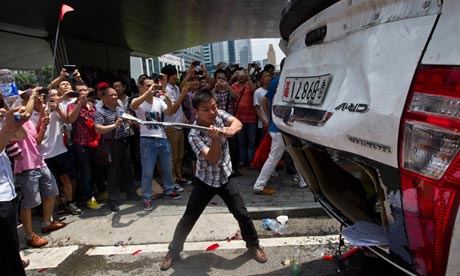
| The main challenge for the Middle East is curbing violence. |
Obviously, the major risk for foreign investment is violence. However, this risk can be mitigated as over 90% of violence occurs in seven of the 18 provinces. The other problem is corruption, as the country has been compared with North Korea and Afghanistan in terms of corruption. It is noticeable that these problems are relatively non-existent in Kurdish northern Iraq. Kurdistan has raised per capita incomes while keeping peace and has discovered oil reserves around 45 billion barrels. It is possible that Kurdish oil production will reach a million barrels per day by 2015. Constant talk of independence and squabbles with Baghdad are the only problems for the province, which do have legitimate chance of sparking into a conflict.
Afghanistan has responded similarly after American invasion. The World Bank has reported that 2012 saw 11% growth in Afghanistan, due to an exceptionally good harvest. This slowed inflation and Afghanistan is almost at food self sufficiency. However, the country faces momentous security concerns with the Americans vacating the country and the constant threat of the Taliban regaining control of the country through violent means. Elections in 2014 will most likely be accompanied by violence as Mr. Karzai is constitutionally barred from entering a third term in office. It is recognized that the Afghan National Security Forces is quite competent and has the ability to control the major cities and protect citizens against insurgency due to the enriched training received by NATO forces. For now, Afghanistan must concentrate on creating a more peaceful country by mitigating the Taliban threat.
Peace is not a term used much in Syria right now. The economy is the not exactly a major concern for Syria right now, as a violent multi faction civil war has caused The Economist to entitle an article on Syria "The death of a country". The Arab Spring protestors were attacked by the Assad regime with tanks, which sparked the conflict. As jihadists enter the country, it is hard to differentiate the different sides to the conflict. Economically, a Syrian economist predicted a decline by 10-20% in 2011 GDP while the Syrian pound has fallen from 50 pounds to the dollar to more than 200. Prices are rising while Syrian currency is almost worthless. In 2012 foreign trade fell by 97% with GDP dropping 30% in 2012 and another 10% most likely in 2013.
Syria's economic problems can be associated with the civil war, a war in which the world has suspected chemical weapons being used while millions are displaced. Personal stories such as a young 14 year old being brutally assaulted and murdered for making a small joke have horrified the world, which has caused the United States to take notice. While the US wishes to enforce a no fly zone, the Russians continue to supply the Syrian government with weaponry advocating for no involvement from the rest of the world.
Even as the opposition political group elects a new leader Ahmad Jarba, there is little belief that this conflict will end soon. Mr. Assad is too strong to simply lose the war, but too weak to defeat the many different types of rebels. Hezbollah, al-Qaeda, the Taliban all have members in Syria, along with other rebels with different beliefs. Disunity of the rebel forces will ultimately extend the violence in the country, and most likely increased concern by the international community could cause intervention.
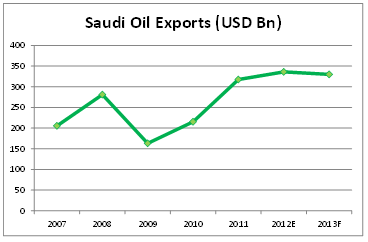 No stranger to international attention is Saudi Arabia, which recently made headlines after banning a man from an event for being reportedly too handsome. As the second half of 2013 looms, Saudi growth has become more moderate. A large stimulus package given by the Saudi regime stopped any Arab Spring action, as the economy is expected to grow around 4% in 2013. The Arab Spring has been profitable for the Saudi's, as the end in Libyan production along with turmoil in oil markets couple with sanctions in Iran have increased demand for Saudi crude.
 Policy wise, the government has created a program which penalizes companies should they decide not to hire enough Saudi nationals. Construction fueled by the stimulus should accelerate growth, as economically the country is doing fine. The greatest complaint is the lack of woman's rights in the country, which is slowly being liberalized, admittedly at a snail's pace. The largest concern is succession, as there is controversy and speculation on who will rule the thrown when King Abdullah ends his reign.
There are many more countries that can be talked about in the Middle East, such as the rise of Qatar or Kuwait. The main issues surrounding the Middle East have been covered in this article, which give rise to the following assertions:
- Israel and Iran will enter into a new uneasy and suspicious relationship as Mr. Rouhani enters the Presidency. Iran will seek to end their economic strife which most likely will cause some latitude in the nuclear talks, hopefully stagnating any military option in the region.
- Iraqi growth will surprise the world as sectarian violence becomes less common in a majority of the country and more international corporations decide to test the Iraqi economic markets to profit off of oil revenues.
- Afghanistan and Saudi Arabia will see increased scrutiny on who will take over from their respective leaders, King Abdullah and Mr. Karzai. Election in Afghanistan most likely will be fraught with violence while internal politics will govern the succession of the Saudi King.
Economically, Israel most likely is the safest bet in the region as the country offers the most freedom and security in the region. External threats are problematic, but none can doubt the economic opportunity in the country. Overall, Middle Eastern violence has been sensationalized by the media which is quite unfortunate as there are many other issues to look at besides car bombings. Hopefully, the world will realize there is opportunity in the Middle East as it is filled with people looking for a peaceful existence, like the rest of the world. 


 Posts
Posts

