Alexonomic's Outlook for 2013: South America

Yes, the Brazilians are still the centerpiece of South American economic growth, yet there are competitors arising. While Venezuala faces a period of uncertainty with the potential replacement of Hugo Chavez, Argentina offers a renewed challenge to the Falklands under Cristina Fernández de Kirchner.

Alexonomic's Outlook for 2013: Europe

Europe reminds many historians of conditions during the 1930s. Economically depressed countries are embracing extremist political parties with racial divide, riots, and anger as the symptoms. Currently, most of the population is aware of the European debt crisis. Although a serious as the economic crisis is, the side effects of lower economic output can be more serious.

Americans and their Guns

To stray from the Predictions of 2013 series, I did an infographic of the gun control debate raging in the US, along with some statistics. The objectives of Obama gun control rules come plainly from the White House publication on the topic. As one can see, the proposed regulations are quite practical.

Alexonomics' Outlook for 2013: Africa

Egypt has often been the focus of news in Africa as of late. The removal of Mubarak and election of Mohammed Morsi has proven to be an interesting turn of events, but the excitement is far from over. Morsi symbolically removed ties from the Muslim Brotherhood, but that move hardly removes the influence the party has on the President.

A guide to Environmental Economics

Often, articles will be conclusions with a few supporting facts that will often sway the reader. I find this problematic for two reasons. First, the reader does not have the chance to fully understand the topic because no background is given. Secondly, the reader doesn't really have an opportunity to disagree with the writer's conclusion if the reader has little to no knowledge of the topic.

Monday, 16 July 2012

All You Need is a Bit of Confidence


Have you ever had a good friend? This friend you know you can trust, you have faith in them, you feel as if you can tell them anything. This friend was there for you when there was a family death, and always went out of the way to ensure you were happy. However, lately your friend has been acting strange. They don’t communicate as much with you, and when they do it’s abrupt and brief, often going weeks without saying a word. The little surprises you had grown accustomed to are now gone; although wondering what’s occurring in your friend’s life you decide to not ask feeling it’s too much of a burden.

However, suddenly you discover your friend has been in trouble.  After a sudden event, drugs and alcohol had consumed your friend in a depressive state. Again, you decide that it is best to do nothing and continue on. Then you discover that your friend has been borrowing quite a bit of money to fund bad habits, and is in heavy debt. Again, doesn’t matter. However, the event that gets you involved is when you find out your friend has forged your signature for a line of credit they cannot pay.

Now you’re involved.

The result of this is probably little to no trust in your friend anymore, while at the same time an epiphany that you should have been there from the start – when the warning signs were present.
This is an analogy of a word that is repeated in financial news quite a bit –confidence. Consumer confidence, market confidence, is basically a measure of how much faith there is in the economy. Like the anecdotal friend, if the population has less confidence in the market the less chance individuals will take risks associated with improving or creating business.

The story also shows how trust between financial institutions and govern and the consumer have fallen. At first, banks were well trusted before 2007, and the consumer had been appreciating the relatively easy credit that could be gained through financial instruments such as line of credits or reverse mortgages. However, despite their being heavy warning signs of many living outside their means, the consumer continued to take the ‘gifts’ from the bank without hesitation. Then, 2008 occurred and suddenly the banks were bailed out by the government. The consumer distanced themselves from the banks and decided to let them figure it out themselves. Trust has continued to fall with the LIBOR scandal and various trading scandals such as UBS. This is the ‘drug and alcohol’ part of the analogy, as these scandals are eroding what faith the consumer had in financial institutions.

However, the consumer is starting to realize how they are tied to the banks. The governments rely on banks in many cases to provide budget funding to deliver on social programs that the consumer appreciates, or pay wages or supply pensions to the consumer. All of a sudden, austerity causes these programs to be slowed down or completely cut out. Again, this is when you realize the friend from the initial story has forged your signature – and now you must take action.

This analogy is far from perfect, but it does show the connection. Financial institutions are heavily connected to Western daily life, and their decline is beneficial to no one, except anyone who has been shorting them for the past 4 years. Instead of ignoring the issues and simply not trusting financial institutions, educate yourself about proper financial planning in your own life instead of simply taking the advice of someone else at face value.

Market confidence, like trust in friends, is very difficult to revive. With the past scandals that have taken place and especially with something as massive as LIBOR, it could take years. What happens without market confidence? Well let’s suppose I wanted to open a business. To open, I need capital of around $50 000, and could apply for the loan. However, I am unsure that the interest rates will stay the same, and with a worsening economy am less unsure that people will purchase my product, which would cause me to fall far into debt. Therefore, I do not take the risk – and decide to continue working at the government.

If I would of have had faith in the economy, I would of taken the loan and paid interest to the bank resulting in profits for them. I would have hired a few employees resulting in less governmental dependents, and my business (should it be profitable) provides more taxable revenue.

It’s all about confidence.

So, what can we do? Continuing with the analogy, instead of waiting for your friend to deteriorate into a worsening state, call them and ask what’s up – or maybe surprise them somehow. The meaning behind this is education about basic financial terms instead of simply taking a line of credit without full understanding. Do some research before making a financial decision such as purchasing a house, instead of buying one based on emotion without fully understanding the difference between a fixed or floating mortgage, or having a proper down payment. By being a more responsible consumer, you are assisting your friend, or the financial institutions in the long term.

How?

If you add stress to a bank, employees whose livelihoods depend on their divisions profit lines will feel forced to make wrong decisions that will most likely be profitable in the short term but devastating in the long term. No, I am not blaming the consumer for the illegal actions of others. However, I am assigning a value to ensuring you are financially responsible, and making sure you are not classified as a toxic asset on a bank’s balance sheet. Additionally, there is value to not supporting additional lending by government agencies in order to continue unsustainable social programs that add a marginal benefit to your life.

It’s a lot easier to not involve yourself in what seems to be a friend’s sole problem, but you’d wish you would have when all of a sudden you feel the after effects.


Reuters on confidence.
The end result of toxic assets.

Thursday, 12 July 2012

And now back to Iran.


Ok, I’ll bite.

I once wrote about the Iranian situation, describing the history of the country, potential impacts of a conflict and logically concluded the best path was to allow the Iranian people to enact change by themselves. Similar to the Arab Spring risings, the Iranian people have an underground that is devoted to removing their current ideological government.  With help from the international community in the form of economic sanctions, the government will be forced to make some changes eventually.

Currently, the situation has deteriorated. The Russians have sent a fleet of 11 warships to Syria enhancing their power in the region. They’re strongly against military action in Syria and Iran due to the amount of business Russia conducts with these countries. Iranian commanders are conducting more war games and have threatened again to close the Strait of Hormuz – a vital water way that controls a large amount of the world’s oil supply. In response, the United States has upped their presence in the region and simply stated that it will not allow the Strait to close.  Israel has also shown more willingness (although they have always been willing) to engage in military operations against Iran.

And now the sanctions are affecting Iranians in Canada. TD has decided to follow sanctions and prevent Iranian – Canadians who engage in financial transactions with Iran – from using their services. The Canadian department of Foreign Affairs has warned the Iranian embassy that they should not be using Cultural Events (such as the one hosted at Carlton University) to recruit Canadians to serve Tehran.  The head of the Foreign Ministry’s wife, former Ms. World and Iranian Ms. Afshin-Jam, has seen increased threats to her safety. She wrote to Carlton University against their association with the Iranian Embassy stating:“[Ayatollah Khomeini] was a man who was personally responsible for the death and torture of countless innocent Iranians.” She is correct. Although I stated in my history of Iran the problems caused by the Shah and his tyrannical methods with the assistance of Western powers, the Supreme Leader has not been much different. At his command, many executions have taken place in the name of Allah.  Interestingly, he did decree a fatwa to treat those of Jewish origin well, but those belonging to the Baha'is were persecuted. While ruling Iran, he also managed to suppress economic progress with policy based on his on ideology.

So now what?

Well, I agree Iran should not have the capability of producing nuclear power simply because they do not have the checks and balances to use the power responsibly. Already the world has seen Pakistan become a nuclear power, one of the most unstable regions in the world ruled by a bizarre interpretation of Islam. This should not happen again. So I agree with Canada supporting economic sanctions, and to be honest Canada does not have much of a choice. America is enforcing these sanctions and disagreeing with them would be economically wrong, simply because we do far more business with Americans than Iranians. Locally, TD seems to be a bit over zealous in enforcing the sanctions and should probably consider a bit more liberal policy; work with their Iranian customers personally to solve any issues.

However, I agree with Ms. Afshin-Jam when she states: “They try to connect with the greater Canadian public and either confuse matters on what’s really taking place in Iran, try to befriend people in the Iranian-Canadian community and maybe even try to monitor them that way.” It is very easily to distort reality to Iranian-Canadians who are second generation. Many of these people feel a strong sense of nationalism, but do not know the very real problems in their country. The Iranian embassy has a strong need for those with Canadian passports as that documentation is golden in the world for travel, and if needed for any espionage purposes – could prove invaluable.

“[Iranian-Canadians] call it the ‘house of terror,’” said Sayeh Hassan, a Toronto-based criminal lawyer who fled Iran 25 years ago and has for years pressured Ottawa to close the embassy. “I don’t want to see Canada become a safe haven for the Islamic regime and those affiliated with the dictatorship, rather than a safe haven for people who are running away from the dictatorship.”

I will take Mr. Hassan’s word, and agree with the sanctions we have in place for the time being.


“Who are your favorite heroines in real life? The women of Afghanistan, Iraq, and Iran who risk their lives and their beauty to defy the foulness of theocracy. Ayaan Hirsi Ali and Azar Nafisi as their ideal feminine model.” Christopher Hitchens 


Quotes from the National Post

Wednesday, 11 July 2012

LIBOR: The Syndication of Banks


Commonly known in the finance world, LIBOR is one of the main interest rates used in many calculations around the globe for all kinds of financial products. I believe one stat I read stated it is included in 800 trillion dollars’ worth of financial engineering.

However, most don’t know what all the fuss is about so I’ll quickly go through the basics. It’s already been summed up in many worthy publications which I’ll link below – but here is my take on it. The London Interbank Offered Rate (LIBOR) is an interest rate that is calculated for 10 different currencies and 15 borrowing periods. Each currency has a panel of banks that report their interbank lending rate, and this is reported to the British Bankers Association, which then reports to Thomson Reuters for the daily calculation. The rate is released around 11 am London time. 

Traders realized that if they could falsely manipulate the LIBOR rate, millions could be made even with a move of 0.01%. So, in accordance with bankers, some banks reported false interbank interest rates being charged in order to lower the LIBOR rate. I should reiterate quite a few banks engaged in this activity. For example the Royal Bank of Scotland reported lower interbank rates than healthier Banks even though it had been locked out of financial markets due to its financial condition.  Since LIBOR is used as the basis in most financial transactions, banks could then borrow money with lower interest rates and lend it out at higher rates. Also, trader’s having knowledge of what the LIBOR rate would be in the future allows more accurate predictions when deciding whether to buy or sell any financial instrument from any type of derivative to deciding whether to buy/short shares in a bank before reporting.

Why is this big deal? Well, the Economist labeled the lot of deviants Banksters while the Washington Post compared the dealings to that of a cartel. The comparisons are actually quite deserved, as these institutions should be competing with each other for business, not manipulate business through syndication. Adding to this, LIBOR was supposed to be a rate used as a basis for financial transaction – a non-biased number.  The whole process will now be placed under review as it has been corrupted.

How does it affect you? Well, if you contribute to any pension fund, have a mortgage, student loan, or are involved in almost anything that involves the stock market – you have been affected somehow. It will be really difficult to gauge the true cost of what has transpired, but the biggest cost has been market confidence – which has already been in free fall since 2008.

Simplistically, this is what has occupied the news outlets headlines over the past few weeks.


Here's some sources that go into far better detail: 
Telegraph             Washington Post            Economic Times            The Economist           Business Insider (thanks Reddit) 

Monday, 9 July 2012

Environmental Economics: Conclusion (Part 6)

Often, articles will be conclusions with a few supporting facts that will often sway the reader. I find this problematic for two reasons. First, the reader does not have the chance to fully understand the topic because no background is given. Secondly, the reader doesn't really have an opportunity to disagree with the writer's conclusion if the reader has little to no knowledge of the topic.

This is the reason I decided to write five lengthy articles before this one. A full summary on  Genetic Engineering , Energy , Water Management , Land Degradation and Conservation has been given allowing the reader, should they read the previous articles, the full opportunity to disagree with my conclusions. On a related note, I often wonder if voter's in democratic countries should take some sort of basic test on a range of subjects ensuring limited knowledge to make a half educated vote. Personal thoughts aside, let's get to the thesis of this conclusion.


Environmental issues are often related to each other, and like this the economic success of a country is heavily linked to the environment for a variety of reasons. Notice I said linked, and not correlated. Look at genetic engineering; its effect on health of not only people but farmers who sell their product on the open market. Additionally,  genetic engineering affects conservation efforts as organic species are polluted by manufactured genes through evolutionary processes. This changes the ecosystem and could have an effect on the forest industry; a gene that destroys trees somehow infects a forest and begins to kill trees could destroy the company that harvests and sells the timber. That forest becomes desolate full of rotting, stale wood and a fire winds up destroying it degrading the land and for use and turning it into a useless plot. The dependants of the forest turn to another area to maintain their lives which doubles the load on that area's environment. The water supply now has an additional load to carry in terms of agricultural and human consumption purposes.

This all began with one gene mutation.

Although the example is obviously overtly an exaggeration, the point being stressed is the idea of the butterfly effect, or a chain reaction. With that in mind, arguing that policies need to be looked at from a far more holistic approach rather than segregated is appropriate.

First, we need to put some numbers in place in order to properly quantify these issues. Remember, these numbers are simply hypothesis’ put together from a variety of sources, but proper sources I might add.

Obviously, one may expect a correlation between rising consumption and production of genetically modified food, and cancer rates. Below is a graph showing the average growth rate of HT Soy, HT Cotton, Bt Cotton, Bt Corn, and Ht Corn as a percentage of total agricultural production in the US. This I compare to rates of cancer mortality per 100 000.

Interestingly, there is no correlation; in fact they dissociate each other. If you research the subject, some studies have suggested that the GE Soy may prevent colon cancer, which is one of the weights I used in the graph. Again, I cut out the weights and did a direct comparison between the growth of genetically modified soy production and colon/rectum cancer. The results if anything show that the rise of production of genetically modified soy correlates to decreasing colon cancer deaths. Again, these graphs do not take into account many variables such as increased research, better medical treatment, or environmental factors. 

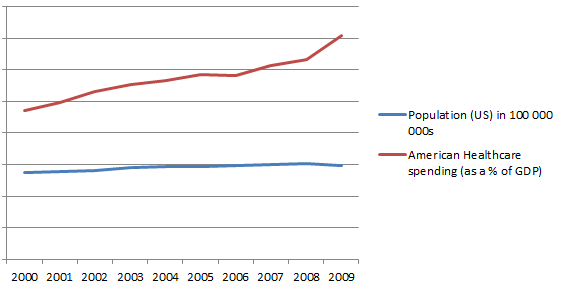
However, the economical mind comes into play. Looking at spending in terms of health care in the United States is a pretty solid indicator. First, to ensure that the rise in health care spending in the United States is not simply due to population growth, the first graph I will show is between those two statistics. Again, from 2000 – 2009.


As seen, the population in the United States hasn’t changed much in comparison to spending.  The population in the US grew from roughly 275 million people to 300 million, while the percentage of GDP spending that was health related grew from 4.72% to 7.1%. Remember, this is before what is known in the United States as Obamacare will come into play, and Obama’s plan will see health care costs continue to increase.  

The rise in obesity in the States has been rather large, and although I do not have a graph for it, it is estimated that currently 130 million Americans are considered overweight or obese and cost society $117 billion. This includes doctor visits, medication and hospital care. Obesity is related to high blood pressure, high cholesterol, and cancer. It is also interesting to note that a study conducted at Monsanto Laboratories (a large GE producer) reported here that the evidence their products contributed to obesity was quite strong. In fact, an increase of around 3.7% of body weight was found along with the liver growing by 11%. The study tested GMO corn against rats.

With soy and corn to be in most consumer food products, I did an average growth of agricultural production verse health spending.

As shown, a correlation between the two is found. With studies showing some negative effects from GMO foods, and with these correlations between spending and healthcare, it is a possibility that increased consumption of GMO foods does contribute to overall health spending due to negative health effects. However, as shown before cancer mortality rates do not correlate at all with GMO food growth. Remember, these are cancer mortality rates not incident rates, so it could be the fact that better patient care and increased research has lowered the mortality rate.

Even if GMO’s account for a 30% of increased health costs, the question policy makers must ask is it worth that cost in terms of providing cheaper food.


GMO foods are only part of the equation. Energy production can often play a part in the health of the local population. This can be seen in Alberta, where the commonly named Oil Sands are being used to extract bitumen or synthetic oil. As stated here, Alberta has commissioned a group to report whether the oil sands can be linked to an increase in cancer, as the wildlife certainly has. Tumours in fish are rising around Lake Athabasca, and interestingly droughts are occurring more often.

Although the Oil industry is quite innovative, there are certain issues that have not been solved. First, one barrel of bitumen requires 2 – 4 barrels of freshwater for extraction and upgrade, while mining processes use 12 barrels of water to produce one barrel of bitumen in surface mining which 70% of said water is recycled. In 2011, annual water consumption for mining, in situ and upgrader operations was 170 million cubic meters. Remembering that 70% of human water usage is agricultural use, a link to agriculture can be made.
By comparing bitumen production verse Edmonton precipitation over the last 13 years, a correlation appears in which with rising production of bitumen, there seems to be less annual precipitation. 


A similar design when comparing synthetic crude production against precipitation appears, although not as clear.


Now, one may think that there would then be a strong correlation between crop yields in Alberta and oil production – however that is not the case. Although I only have the crop yields from 2004 until 2009, the yields have stayed within a range of 26 300 000 tonnes to 300 000 000 tonnes. As shown below, any correlation is pretty much non-existent.

I cannot relate precipitation to crop yield as I only have Edmonton precipitation data, not for the entire province. However, it is curious that crop yield has seemingly been less affected than it should be from oil production. Although currently the prairies are dry, the crop yield this year should be fine.

Two issues arise that could be the reason behind this curiosity. First, using Edmonton rainfall is not representative of the entire province, and using another city or the province may produce a different graph. Second, the rise in GMO seeds could play an effect in ensuring agriculture success even in dry conditions, as many GMO agricultural products are made to be less affected by droughts.

Now, as stated before here the problem with switching from fossil fuels is not only cost, but also technological problems and an unpredictable environmental effect. Wind power is relatively expensive to maintain, requires quite a bit of starting capital to create one windmill, is problematic technologically, and has been linked to health problems such as Wind Turbine Syndrome. Solar Power has a 30 year shelf life, and the chemicals used in creation are fairly toxic causing environmental concerns, and this is not mentioning the low level of efficiency. Nuclear Power has a very expensive initial cost, and the radiation issue will constantly be a threat. So, the world will most likely still with burning fossil fuels to produce energy for the foreseeable future.  

Again, it is very easy to see how all these issues relate. Energy policy in terms of oil production affects water management in terms of precipitation correlations or problematic tailing ponds. This issue roles into land degradation as droughts deteriorate land to an unusable state, and also touches GMO foods as less water could cause farmers to use genetically modified drought resistant seeds.  Conservation is touched by all of these issues, as genetically modified organisms can interrupt an ecosystem and potentially hurt a species, or the destruction of water resources having a long term effect on any environment.

Placing a price tag on conservation, water management or land degradation is almost impossible. To exemplify this, let’s combine the issues of GMO’s, land degradation and water management.  A farmer decides to use irrigation for his crops and diverts the ground water for his crops. The farmer uses GMO’s to have better control over pests and cut maintenance costs. The non-organic plants drain the soil of nutrients while the diverted water eventually contributes to degrading of the land (if the irrigation is not done properly). Thus, the farmer destroys his land in an effort to cut short term costs, but eventually faces higher long term production costs as the land deteriorates over time – which sees his selling price rise in an effort to profit. 

Less land that can be used for agriculture doesn’t necessarily mean higher food prices in the short term. With government subsidization, and short term fixes, food prices are not a good index for measuring agricultural problems.

Interestingly, to solve these problems many techniques can be employed. Using crop rotation, organic seeds, a drip system instead of irrigation, and the land can be used sustainably to product a regular crop for years to come.

As shown in the previous articles, economically quantifying these issues has been attempted through systems such as natural capital, or using environmental assessments to understand the impact that a certain industry can have on a property. The problem is we’re not entirely sure, there is far too many variables that are not understood on our planet.

Recommendation

Environmental issues need to be looked at from a more wholesome perspective in order to adequately solve problems.  As I have repeatedly stated throughout this conclusion, there is a far greater chain reaction when looking at environmental issues than other topics. One domino will hit another. To prevent this, policy makers should try looking at the first domino. That is, consult a panel of specialists in specific fields in the environment, and do not rely on simple general knowledge of the environment when making a decision. Seeing how everything relates and how one decision can cause three more problems should be a key thought when developing an environmental policy.

I will also stress the importance of ensuring the difference between preservation and conservation. We preserve museum artifacts; we conserve the environment – which is a resource. Often, political powers will be swayed by environmental groups that have little understanding of that concept, and problematic policy will occur. This can be seen in Ontario under Dalton McGuinty, as the forestry industry has been cut in half, coal plants shut down while money spent on expensive less efficient green energy, and conservation laws often end up problematic as species become overpopulated when they should be controlled.

With these points in mind, the following is what this report shall suggest. Use a combination of fossil fuels (mainly coal), existing hydroelectric plants, and nuclear plants to drive energy production. Then introduce a green energy fund of $50 million, which will be run by private individuals who have technological, entrepreneurial and business experience. This fund will give capital to inventors who create the best ideas in terms of renewable energies. In order to prevent the disaster in the United States (Solyndra and others), these companies will be groomed slowly to replace nuclear plants as they are shut down due to their shelf life. Additionally, garbage collection into landfills should be ended, and replace with incinerators. Garbage can be loosely looked at as a renewable resource, and should not be forgotten.

New construction should be considering attempting to create sustainable buildings, and a think tank to develop a code for buildings that produce their own energy and are more efficient should be created. I am well aware of LEED certification, but this think tank would be more concerned for structures to produce their own energy through solar shingles, geothermal power, or utilizing the wind.This cannot be an immediate process, but a long term goal that should be planned out along the scope of 15 years. This will limit the effects on the construction economy.

A board will be created of water management specialists, land degradation specialists, all types of energy specialists, conservation experts and representatives from the GMO industry to offer opinions on different policies, and outline how one law will have an effect on various sectors. This will allow a new policy to be molded to minimize problems and maximize benefits. This board should be as nonpartisan as possible, and political affiliations should be shunned, especially lobbyist connections. Additionally, this board will be seen as something like the judiciary, separate from government and have limited veto power on certain policies.

A sub segment of this board will engage economists and conservationist authorities to place a value on land, and determine whether the land in question for development serves better economically for environmental or modernization purposes. This is in line with the system of natural capital that has already been referenced.

Concerning water management, specifically in Canada greater care should be taken in regards to limiting the destruction of water resources. Already water management is being improved upon drastically by oil producers, so I see a bright future in terms of the oil sands management. Globally, drip systems should replace irrigation systems as they are far more efficient. Water should not be privatized, but rather a public/entrepreneur partnership should be created. Using crowdsourcing, water utilities can offer rewards for the best ideas. Additionally, improvement upon water infrastructure will have to occur.

I fully believe an open source library should be created for Genetically Modified Organisms, so fresh eyes can view the structures and offer new ideas. More restrictions should be placed on GMO producers. I think an outright ban is ridiculous, research should continue. The problem is the commercialization of something like this can see greed cause problematic decisions made that only are positive in terms of profit – but negative elsewhere. The industry should be audited regularly, and to be honest it would make a lot of sense to see the GMO industry as entirely not for profit. The reasoning is research into these products affects the entire world, and should be used fairly carefully to ensure the negative effects that have been discussed here are minimized.

In terms of conservation and land degradation, these two concepts relate pretty closely together. Creation of a natural capital system to rate land in economic terms should assist in the mitigation of both problems.

As seen through numerous examples, all environmental issues should be looked at holistically. They are all interrelated and have an economic impact even though it is difficult to quantify. In order to necessarily create proper environmental and economic policies, experts from both fields should work together to properly create policies that can ensure a sustainable future. 

Thursday, 5 July 2012

Environmental Economics: Conservation (Part 5)

When I was a kid, I was forced by my parents to work in the garden. As a result of this, I learned the basics of farming while at the same time grew an appreciation for nature. The forest that backs on to my property today will often be occupied by me zipping through on my ATV, polluting the peace with the noise of an internal combustion engine.  I am not much of a hunter as I am not very patient, but I have taken some courses and received a few licenses. I will say this; most hunters have a far, far better understanding of conversation than many self-titled environmentalists. Why? Their sport and livelihood depends on species conservation.  

Conservation is often in the news for the wrong reasons. For example, the seal hunt was popularized simply because the animals were cute to stick on TV and clubbing them to death simply seemed wrong. Although many types of conservation exist, the definition for discussion will be of focusing on maintenance of the natural world’s ecosystem through seeing the continual existence of key actors. Basically, conservation is a form of long term planning. Exemplifying this is the Fishing Industry. Conserving fish through capping the amount of fish that can be caught in a certain area ensures that fish can reproduce and fishermen will have fish to catch for the following year.  One of the better definitions of conservation was stated by Carl F. Jordan who stated “Biological conservation as being a philosophy of managing the environment in a manner that does not despoil, exhaust or extinguish”.

The world has been slowly looking at conserving and enacting long term plans on it. For example, 10% of the world is somehow legally protected like National Parks such as Yosmite. As modernization increases, the need to protect and ensure the survival of the world’s resources also increases. Conservation biologists study migration patterns, specie demographics, population sizes, mating rituals and habitat needs to assess conservation needs.  A report entitled “Species coextinctions and the biodiversity crisis” (2004) boldly forecasted 50% of the world’s species will be gone in the next 50 years. Although unlikely, it is important to take this prediction seriously and commit resources to conservation. Not for Profit (NPO) agencies as well as government funded researchers are working hard to ensure this prediction does not materialize.

Conservation is not  a new thought, in fact it is an ancient one. Plato, Buddhism, Hinduism, Islam have all advocated for it. In fact, God ordered Moses to not farm land every seventh year. It was actually the Europeans who considered conservation a pagan activity as they embraced modern development. The US actually led the way with John Muir founding the Sierra Club in 1892, or Theodore Roosevelt establishing protected national forests. The Endangered Species Act led the way for protection plans for species across the world. In 1992 the Convention on Biological Diversity in Rio planned the Cartagena Protocol (enforceable in 2004) to protect species from modified organisms resulting from genetic engineering.   The Convention ensured that countries prepare National Biodiversity Strategies and Action Plans.  The Society for the Environment and the Institute of Ecology and Environmental Management are two organizations professionalizing conservation.

It is estimated somewhere between 3.6m and 111.7m species exist, while only 1% of species have been studied beyond simple naming. Basically, these statistics conclude that there is a lot more work to be done. Organizations such as the International Union for the Conservation of Nature are composed of a number of scientists around the world to monitor the changing environment and report these changes by quantifying it.  Interestingly, a system entitled natural capital uses accounting to set a value to an ecosystem before development. Economists and Conservations collaborate to set a certain value to an area before the concrete begins to pour. It is assessed whether a certain land has more value to the global economy as a natural ecosystem providing a steady stream of resources, or as a skyscraper.

Valuing conservation is difficult, but definitely valuable. For example honeybees provide around 10 – 18 billion dollars’ worth of services annually while the continued conservation of forests ensure that the forestry industry will always exist. Conservation is directly tied to the economy.

However, all over the world conservation methods are being attacked. The ivory stock provided by elephants is dwindling by illegal poaching. Fires such as those in Colorado wipe out entire ecosystems and cause environmental carnage. The Prime Minister of Cambodia has just allowed four companies to develop 86 400 acres of land in national protected parks. Due to environmentalists pushing for greener energy, Brazil is planning to develop 30 dams in the Amazon, which causes quite a bit more methane to be released than a traditional gas powered plant as I discussed  here . Shockingly, forest activist Jose Claudio was killed for criticizing illegal logging in Para, a state in Brazil that is suffering from mass deforestation. Greenpeace reported that deforestation in India is being driven by the demand for Palm Oil.  Adding to this is the increasingly risk of mass fires in the Amazon due to the expansion of roads, and people migrating to urban areas – while a new study published by Science claims that 10% of global carbon emissions are a result of deforestation.

However, plans are being made to promote conservation. The US Forest Service, Rwanda, Brazil and Central American groups have pledges to restore 45 million acres of native forests. Google Earth is planning on adding a live update deforestation alert system to reveal to the world how much forest is actually being destroyed. The United Kingdom has created a law ensuring all London Stock Exchange companies disclose greenhouse gas emissions by 2013, while the Western Ghats of India have been recently declared a UNESCO world heritage site as it is considered one of the world’s richest biodiversity ecosystems.

With more support globally, conservation methods such as this are rising. The antics of organizations such as PETA (mainly the American branch) or Greenpeace that make the news often takes away from the real issues at hand. Real analytical thinking regarding the data available shows that conservation is an economical idea, as resources need to be maintained for harvesting and collection if the world is to continue advancing the living standards of the common person. Often, environmental policies that restrict harvesting do not understand that conservation is not preservation. For example, if you do not cut down trees they will die after a certain period (rot from the inside) and be of no economical use.

The environment is not a museum full of dusty artifacts. It is a living ecosystem full of complex parts that must be monitored to ensure longevity. Environmental policy should reflect this reality, and allow resources to be harvested responsibly. 

Monday, 25 June 2012

Environmental Economics: Land Degradation (Part 4)

Imagine traditional societal food supply chains became disrupted through an energy or water crisis, and individuals have decided to grow their own food. However, one looks at their patch of land and realizes something – nothing is going to grow in this area. Depressing thought; people could not have the last resort option of growing their own food. This is a consequence of land degradation, and unfortunately the issue hasn’t been featured too much in the main stream media.

Land degradation is a fairly large international problem, spawning from countries around the world attempting to fast track their developmental pace into a modern society without properly analyzing environmental affects. Defined as the reduction of biological/economic productivity of land is reduced due to manmade processes, the US Department of Agriculture estimates 40% of the earth’s surface is at risk of desertification or already a desert. Basically land degradation is a disturbance to the land that can cause land becoming undesirable who could include soil erosion, deterioration of chemical or biological properties of soil or long term loss of natural vegetation*.

To be honest, not a lot is actually known about land degradation as no developing country has created a department or process to monitor national land degradation. Most of the data used is obtained from experts, field experiments and case studies or land use trends which are used to extrapolate conclusions. The GLASOD study is most likely the most influential study, as 250 experts contribute their assessments. Continuing from the 1940s, GLASOD suggests 560 million hectares of farmland has been degraded (38% of total farmland, while permanent loss due to human activity is estimated to be .3-.5% of the world’s total farmland per year (around 5 million hectares per year).  Due to increased population and hence increased demand for food, the FAO has hypothesized that most arable land expansion will occur in developing countries resulting in tropical forest destruction. Again, in the short term it will appear the cheapest financial option, in the long term the effects could result in large problems.

The Canadian International Development Agency attempts to combat land degradation with sustainable land management. This is done through proper training, education and investments in technical assistance and equipment. Interestingly, CIDA reports that soil conservation practices and responsible environmental practices have reversed effects of low soil productivity of 70% of cropped land in the last 25 years.  The responsible environmental practices referred to consist of maximization of vegetation to prevent soil erosion, replacement of nutrients and preventing the accumulation of harmful substances within the soil.

Governments have used several policies over the years that could hasten land degradation. Subsidization of economic ventures that increase land deterioration while taxing activities that prevent can be seen in many countries around the world.  Sugar Cane import quotas in the United States caused farmland expansion in the Floridian everglades, or heavy Brazilian ethanol subsidization. It is interesting to note that ethanol subsidization has been politically driven to attract the green vote, while practically it has caused far more problems than good. An interesting article can be found here, which explores the political link of environmental policies.

Continuing on, government subsidization for these crops increases economic incentive to destroy land for agriculture commercialization. Political minds may point to these socialistic policies as the source to blame. However, capitalistic market failures can also be seen as a reason behind land degradation. Since landowners profit from exhausting their land through production of items in demand, often landowners will act in the short term and forgo the environmental impact of short term thinking. Additionally, there is little liquidity available in current credit markets to fund conservation friendly farming ventures, and little interest due to the high initial investment. The problem is misinformation as the latter is a false assumption. It has been shown that improving “the functioning of financial markets will facilitate land conserving investments, but may also increase total agriculture investment, leading to expansion of cultivated area” **. Basically, investing in conservation friendly projects has a solid net return both financially and environmentally.

New technologies will also aid in preventing land degradation, as new practices could replenish land and reduce the cost that commercial agriculture on the land. Interestingly, from 1985 – 1995 Thailand saw a 17% reduction of the agricultural labour force as higher labour productivity resulted in the retirement of areas of agricultural land. Basically, investment in proper technology (and I stress proper) will improve productivity of land and decrease the need to allow for more land clearing.

Adding to this, many countries have attempted to establish land zoning, or laws restricting the growth of land degradation. In Ontario the Green Zone is an example of this, and the largest of these programs is actually in China, as the government’s Sloping Land Conversion program targeted an increase of China’s forested area by at least 10% by 2010. These projects are again inhibited by lack of incentive.

However, recently land degradation has seen some promising preventative actions. Recently in Rio de Janerio at the UN Conference on Sustainable Development, 100 world leaders agreed to attempt to slow the increase of land degradation and improve the policy making tools at their disposal. Luc Gnacadja stated that “By 2020 the demand for food is likely to increase by 50%, and by 45% for energy and 30% for water. Each of these demands will claim more land. This will lead to more deforestation unless we commit to restore degraded land”. Commitment from countries is nice, but as seen from precedent it is less likely that most countries follow through on their promises.

A strong case study for land degradation can be seen in Australia which is the world’s driest continent. Agriculture occupies 60% of the total land, and livestock grazing is the most extensive use of land. As droughts and variable rainfall have a large affect on agriculture, Australia has initialized stronger environmental advocacy to prevent future disaster. Programs to create formal resource reserves, protection of land, provide security to wood resources and determine what sustainable wood harvesting levels are, and heavy investment in environmental monitoring has seem some success. A host of case studies can be found here.

To reiterate: deforestation, urbanization, pollution, irrigation, agricultural mining of nutrients cause land degradation. Stressors are erosion by wind/water, salination and alkalinization, destruction of soil structure and removal of organic matter from the soil. These problems have a heavy economic effect in the world, as it is strongly correlates with long term sustainability of current practices.

Again, understanding of this issue is paramount to developing proper policy. Land degradation is affected by irrigation, which is largely seen as a partial solution to water management. Seeing that one solution to one problem could cause another is the reasoning for a holistic understanding of the environment and the realization that the earth is truly an ecosystem that can be compared to dominoes. When one domino falls, it will hit another. The key is to prevent the first domino from falling, instead of attempting to prevent the fifth one from tumbling.


*(the UN 1996 conference to combat desertification can be credited for this definition)